News
10 Companies Join the Environmental Tech Lab’s Newest Cohort
Mar 23, 2026
The NYC Department of Environmental Protection (DEP) runs one of the most complex water and wastewater systems in the world. Every day, it delivers more than one billion gallons of clean drinking water to nearly 10 million residents, including 8.5 million in New York City, treats 1.3 billion gallons of wastewater, maintains 7,500 miles of sewer pipes, and manages air quality, pollution reduction, and watershed protection. It does this while navigating complex infrastructure needs and the intensifying pressures of climate change. New York City is still recovering from damage caused by Hurricane Sandy, and erratic weather conditions continue to create unexpected flooding and place added strain on the system.
The Partnership Fund created the Environmental Tech Lab with DEP to help the agency meet these challenges with new tools and approaches. What sets our lab apart is the depth of this partnership: we work with agency personnel at every level — from process engineers and water quality managers to commissioners, deputy commissioners, and c-suite budget decision-makers — to identify the agency’s most pressing challenges. This approach ensures new technology solves real operational pain points, and that promising solutions have the executive and operational support needed to scale.
After two months of in-depth discussions with staff, DEP identified two challenges last year: one focused on Operations Optimization & Analytics, and another on Emergency Response & Security, and invited technology companies from around the world to propose solutions.
A panel of 17 DEP subject matter experts evaluated each proposal on strength and feasibility, narrowing the field to 22 finalists. Those companies came to New York to demo their solutions live for over 50 DEP operators and leaders, pressure-testing real-world fit and understanding how each solution could be implemented in DEP’s operational environment.
Ten companies were ultimately selected to move forward, each conducting a minimum viable test of their technology over an eight-week proof-of-concept period. The cohort spans a broad range of capabilities: AI platforms that help operators make faster, smarter decisions; sensors that deliver real-time data DEP has never had access to before; autonomous underwater vehicles; and new approaches to pump maintenance designed to eliminate costly, recurring failures. Together, they equip the nation's largest municipal water and wastewater utility with tools to manage increasingly unpredictable conditions.\
The 2026 Cohort
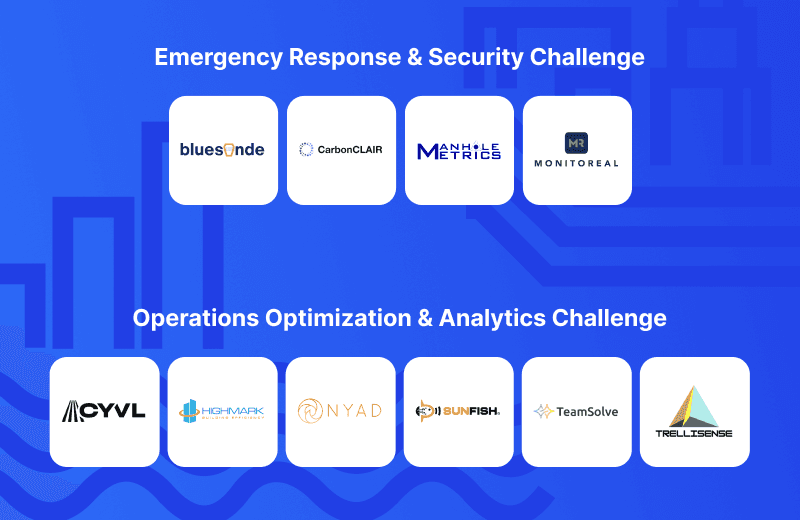
Operations Optimization & Analytics Challenge
Cyvl (Somerville, MA.) uses vehicle-mounted AI and LIDAR sensors to scan city streets and build a 360-degree digital map of above-ground infrastructure like manholes, roads, and signage, helping governments improve safety, stretch budgets, and coordinate maintenance across departments. (Bureau of Water & Sewer Operations)
HighMark Building (New York, NY.) provides OverWatch, a system that removes grease, wipes, and debris from wastewater pumping stations before they cause clogs — cutting downtime, emergency callouts, and repair costs. (Bureau of Water Supply)
Nyad (Birmingham, AL.) provides an AI co-pilot purpose-built for wastewater plant operators, designed to help staff keep their facilities safe, efficient, and compliant by transforming complex operational data into clear, actionable guidance. (Bureau of Wastewater Treatment)
Sunfish (Austin, TX.) builds small autonomous underwater vehicles that inspect hard-to-reach infrastructure faster, safer, and at lower cost than traditional dive or drain-down methods. (Bureau of Water Supply)
Teamsolve (Los Angeles, CA.) provides an AI platform that connects work order records, SCADA data, and lab results to help water and wastewater operators surface bottlenecks, automate workflows, and find answers in data that currently requires hours of manual analysis. (Bureau of Water Supply; Bureau of Wastewater Treatment)
TrelliSense (Boulder, CO.) makes affordable optical sensors that continuously measure methane leaks with high precision, bringing scalable emissions monitoring to facilities of all sizes. (Bureau of Wastewater Treatment)
Emergency Response & Security Challenge
Bluesonde (Portland, ME.) makes low-maintenance water monitoring buoys that stream real-time data without requiring boat trips or constant upkeep, letting teams monitor large areas and respond quickly to changing conditions. (Bureau of Wastewater Treatment)
CarbonCLAIR (New York, NY.) provides mobile air filtration and carbon capture units designed specifically for construction sites, making job-site air cleaner and reducing emissions during infrastructure work. (Bureau of Engineering Design & Construction)
Manhole Metrics (London, UK.) provides affordable sensors in sewer systems that continuously monitor conditions and turn the readings into clear insights for operations, planning, and compliance teams. (Bureau of Water Supply)
Monitoreal (Stamford, CT.) makes an AI-powered edge device that plugs into existing security cameras to automatically detect incidents, trigger alerts, and surface operational insights — all processed locally on the device so video data stays private. (Bureau of Engineering Design & Construction; Bureau of Police & Security)
We look forward to sharing what these companies accomplish.
The NYC Department of Environmental Protection (DEP) runs one of the most complex water and wastewater systems in the world. Every day, it delivers more than one billion gallons of clean drinking water to nearly 10 million residents, including 8.5 million in New York City, treats 1.3 billion gallons of wastewater, maintains 7,500 miles of sewer pipes, and manages air quality, pollution reduction, and watershed protection. It does this while navigating complex infrastructure needs and the intensifying pressures of climate change. New York City is still recovering from damage caused by Hurricane Sandy, and erratic weather conditions continue to create unexpected flooding and place added strain on the system.
The Partnership Fund created the Environmental Tech Lab with DEP to help the agency meet these challenges with new tools and approaches. What sets our lab apart is the depth of this partnership: we work with agency personnel at every level — from process engineers and water quality managers to commissioners, deputy commissioners, and c-suite budget decision-makers — to identify the agency’s most pressing challenges. This approach ensures new technology solves real operational pain points, and that promising solutions have the executive and operational support needed to scale.
After two months of in-depth discussions with staff, DEP identified two challenges last year: one focused on Operations Optimization & Analytics, and another on Emergency Response & Security, and invited technology companies from around the world to propose solutions.
A panel of 17 DEP subject matter experts evaluated each proposal on strength and feasibility, narrowing the field to 22 finalists. Those companies came to New York to demo their solutions live for over 50 DEP operators and leaders, pressure-testing real-world fit and understanding how each solution could be implemented in DEP’s operational environment.
Ten companies were ultimately selected to move forward, each conducting a minimum viable test of their technology over an eight-week proof-of-concept period. The cohort spans a broad range of capabilities: AI platforms that help operators make faster, smarter decisions; sensors that deliver real-time data DEP has never had access to before; autonomous underwater vehicles; and new approaches to pump maintenance designed to eliminate costly, recurring failures. Together, they equip the nation's largest municipal water and wastewater utility with tools to manage increasingly unpredictable conditions.\
The 2026 Cohort
Operations Optimization & Analytics Challenge
Cyvl (Somerville, MA.) uses vehicle-mounted AI and LIDAR sensors to scan city streets and build a 360-degree digital map of above-ground infrastructure like manholes, roads, and signage, helping governments improve safety, stretch budgets, and coordinate maintenance across departments. (Bureau of Water & Sewer Operations)
HighMark Building (New York, NY.) provides OverWatch, a system that removes grease, wipes, and debris from wastewater pumping stations before they cause clogs — cutting downtime, emergency callouts, and repair costs. (Bureau of Water Supply)
Nyad (Birmingham, AL.) provides an AI co-pilot purpose-built for wastewater plant operators, designed to help staff keep their facilities safe, efficient, and compliant by transforming complex operational data into clear, actionable guidance. (Bureau of Wastewater Treatment)
Sunfish (Austin, TX.) builds small autonomous underwater vehicles that inspect hard-to-reach infrastructure faster, safer, and at lower cost than traditional dive or drain-down methods. (Bureau of Water Supply)
Teamsolve (Los Angeles, CA.) provides an AI platform that connects work order records, SCADA data, and lab results to help water and wastewater operators surface bottlenecks, automate workflows, and find answers in data that currently requires hours of manual analysis. (Bureau of Water Supply; Bureau of Wastewater Treatment)
TrelliSense (Boulder, CO.) makes affordable optical sensors that continuously measure methane leaks with high precision, bringing scalable emissions monitoring to facilities of all sizes. (Bureau of Wastewater Treatment)
Emergency Response & Security Challenge
Bluesonde (Portland, ME.) makes low-maintenance water monitoring buoys that stream real-time data without requiring boat trips or constant upkeep, letting teams monitor large areas and respond quickly to changing conditions. (Bureau of Wastewater Treatment)
CarbonCLAIR (New York, NY.) provides mobile air filtration and carbon capture units designed specifically for construction sites, making job-site air cleaner and reducing emissions during infrastructure work. (Bureau of Engineering Design & Construction)
Manhole Metrics (London, UK.) provides affordable sensors in sewer systems that continuously monitor conditions and turn the readings into clear insights for operations, planning, and compliance teams. (Bureau of Water Supply)
Monitoreal (Stamford, CT.) makes an AI-powered edge device that plugs into existing security cameras to automatically detect incidents, trigger alerts, and surface operational insights — all processed locally on the device so video data stays private. (Bureau of Engineering Design & Construction; Bureau of Police & Security)
We look forward to sharing what these companies accomplish.